


Dennis Beardsley, Refinish Application Specialist, Norton | Saint-Gobain
Mandar Joshi, Senior Product Manager of No-Fil Products, Norton | Saint-Gobain
When evaluating paper abrasives, one of the most critical considerations is the grading of the grain. This is especially important when you are trying to achieve the smoothest, most consistent finish.
When it comes to grading systems, the gold standard for abrasive grains is set by the Federation of European Producers of Abrasives (FEPA). FEPA standards have a tighter grain size tolerance than other systems. In fact, FEPA requires 95% of abrasive particles fall within a specified range vs 60% in other systems. By minimizing the chance of larger outlier grain sizes, an abrasive that meets FEPA standards delivers the most consistent performance across different grit levels.
When a grain meets FEPA standards, it is designated as “P-graded.” You may see this indicated in one of a few ways. The two most common are:
- Grit Designation – For P-graded grains, the grit may be listed with a “P” in front (e.g. P100).
- Product Imprint – On the backside of P-graded abrasives, you will see the grit written with a “P” in front (e.g. P100).

Why should a P-grade matter to you?
There are many industries where the goal is to achieve a final surface finish with a uniform scratch pattern and consistent finish. The automotive manufacturing and aftermarket industry are examples. Nearly all major automotive paint manufacturers specify the use of P-graded abrasives, as stated in their technical data sheets. This is to ensure proper surface preparation before the primer or sealer is applied.
Figures 1 and 2 show the marked differences between using a P-grade abrasive and using a less-stringent standard. In Figure 1 where a non-P-grade abrasive was used, you can clearly see the scratch pattern, even at the finer grit levels.
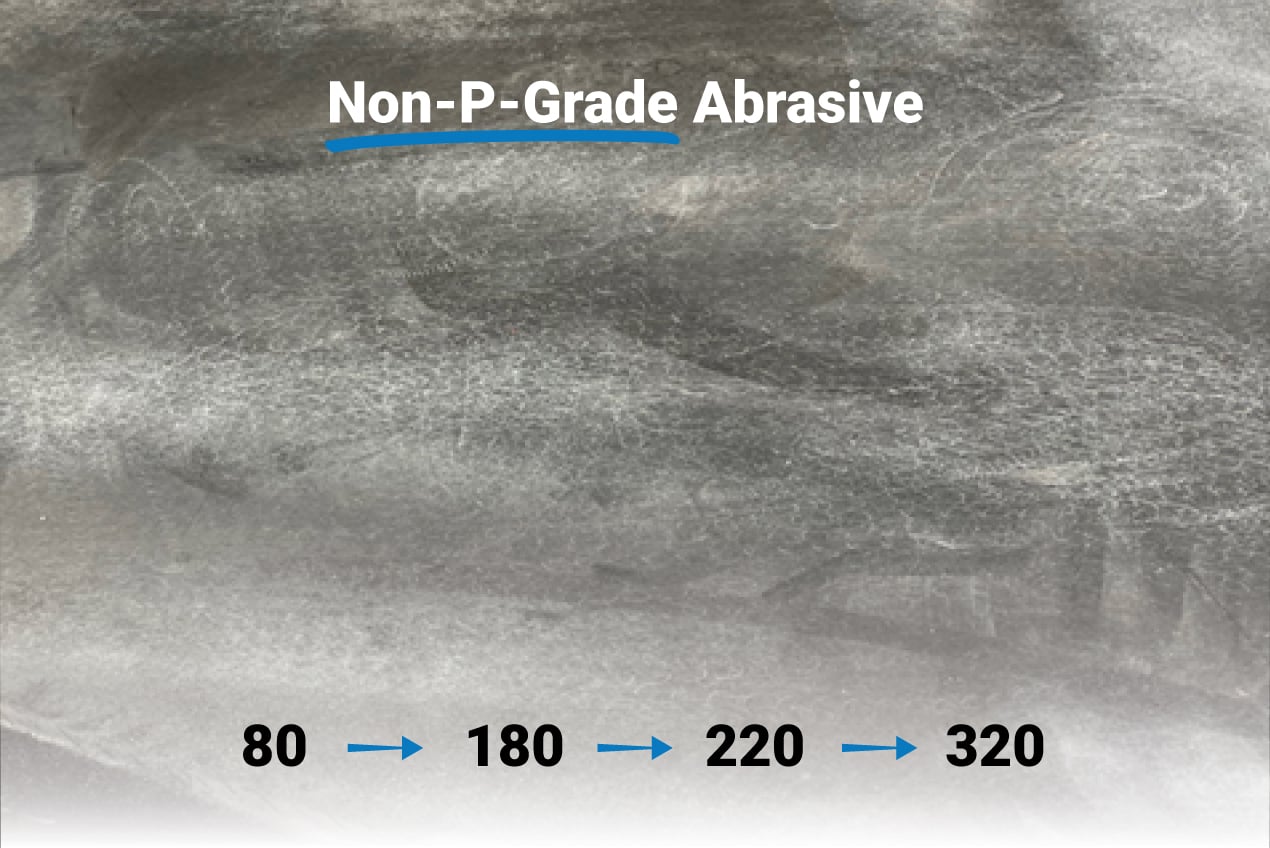
Figure 1: Non-P-Grade Abrasive
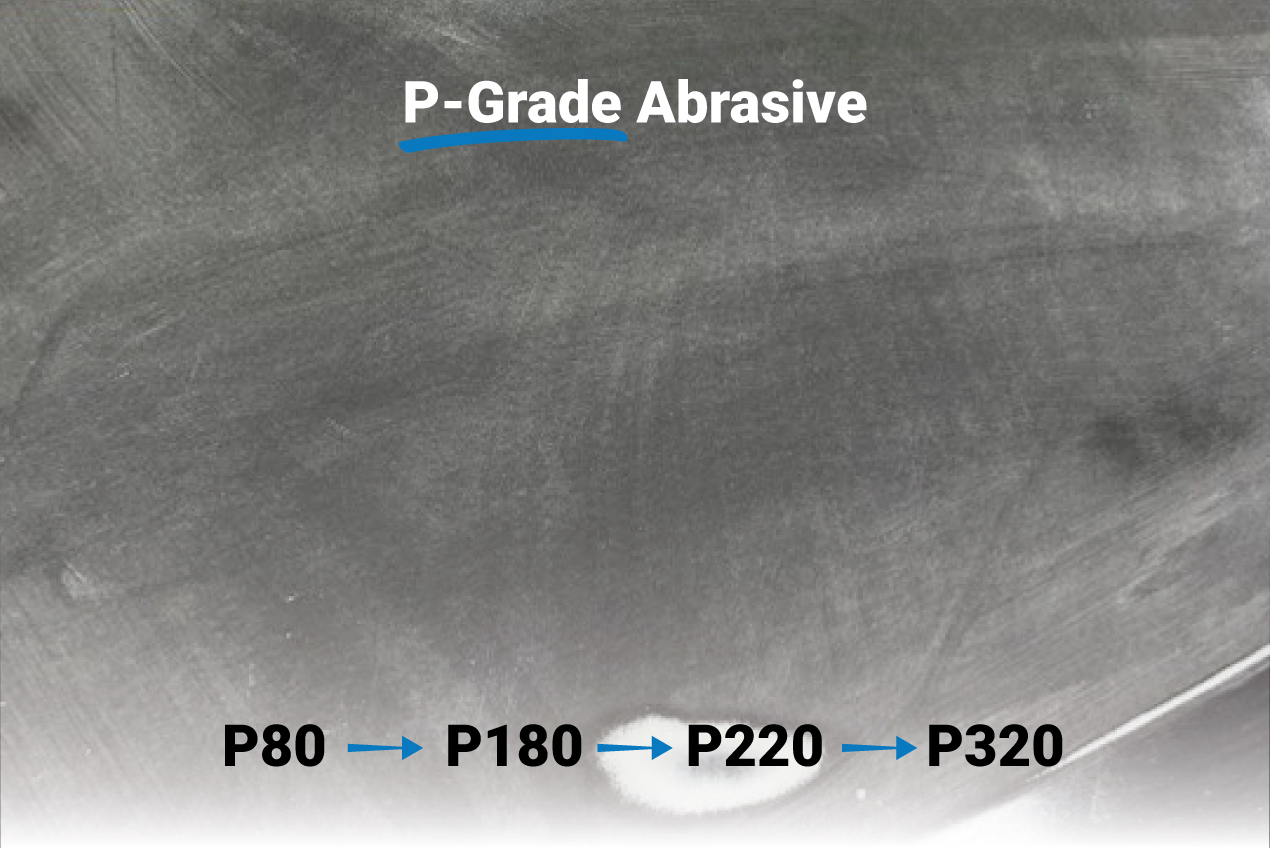
Figure 2: P-Grade Abrasive
In Figure 2 where a P-grade abrasive was used, you can see the much smoother, finer finish – even at the coarser grit levels.
If you were to paint over the surface in Figure 1, those imperfections would show through any color or clear-coat application. If the problem isn’t caught before painting, technicians may have to strip and re-do the process or risk delivering a product that the customer will ultimately reject.
Using a P-grade abrasive helps you avoid rework by creating the right surface finish long before any primer is applied. The smooth finish helps prevent bubbling and cracking by creating a consistent, unified surface.
See the multi-air cyclonic disc conversion process in action in the video below.
Finish Better with Norton
Unlike other abrasive manufacturers, Norton paper abrasives are nearly all P-graded. No other manufacturer offers such a broad portfolio to meet your finish application needs. If you’re interested in learning more, seeing a demonstration, or testing P-graded abrasives in your shop, contact us.
Norton’s No-Fil® Technology Delivers a Fine Finish
Because of its importance to the final finish, most abrasive manufacturers offer some type of anti-loading (or anti-clogging) solution. Norton | Saint-Gobain has engineered a design that uniquely marries grain structure and backing options with an environmentally friendly, proprietary stearate coating called No-Fil.
Get Better Results with Norton Anti-Loading Technologies
Working on any substrate, abrasives can easily become clogged with the material being removed, including metal and wood dust or paint and other coatings. Clogged abrasives interfere with performance and can cause damage to a workpiece. A worldwide leader in abrasives, Norton | Saint-Gobain has developed specific technologies to prevent loading so you can get the finish you want.
About The Authors

Dennis Beardsley
Refinish Application Specialist
For more than 28 years, Beardsley has worked in the Norton Automotive Aftermarket as a Trainer and North American Training Manager. In addition, he’s been an active participant in R&D for new products. Two years ago, he moved into the role of Refinish Application Specialist, working with OEMs in the boating and signage industries.

Mandar Joshi
Senior Product Manager of No-Fil Products
During his career, Joshi has worked in a variety of industries, including automotive components, power tools/consumables, capital equipment, and abrasives. He has served at Saint-Gobain for almost 20 years in many roles, including product engineering, sales/key account management, customer service, and product management. Previously, he was based in India but now works in North America (Canada). His accomplishments include the re-engineering and implementation of the company’s sales and operations business process.